Space is where the battle is
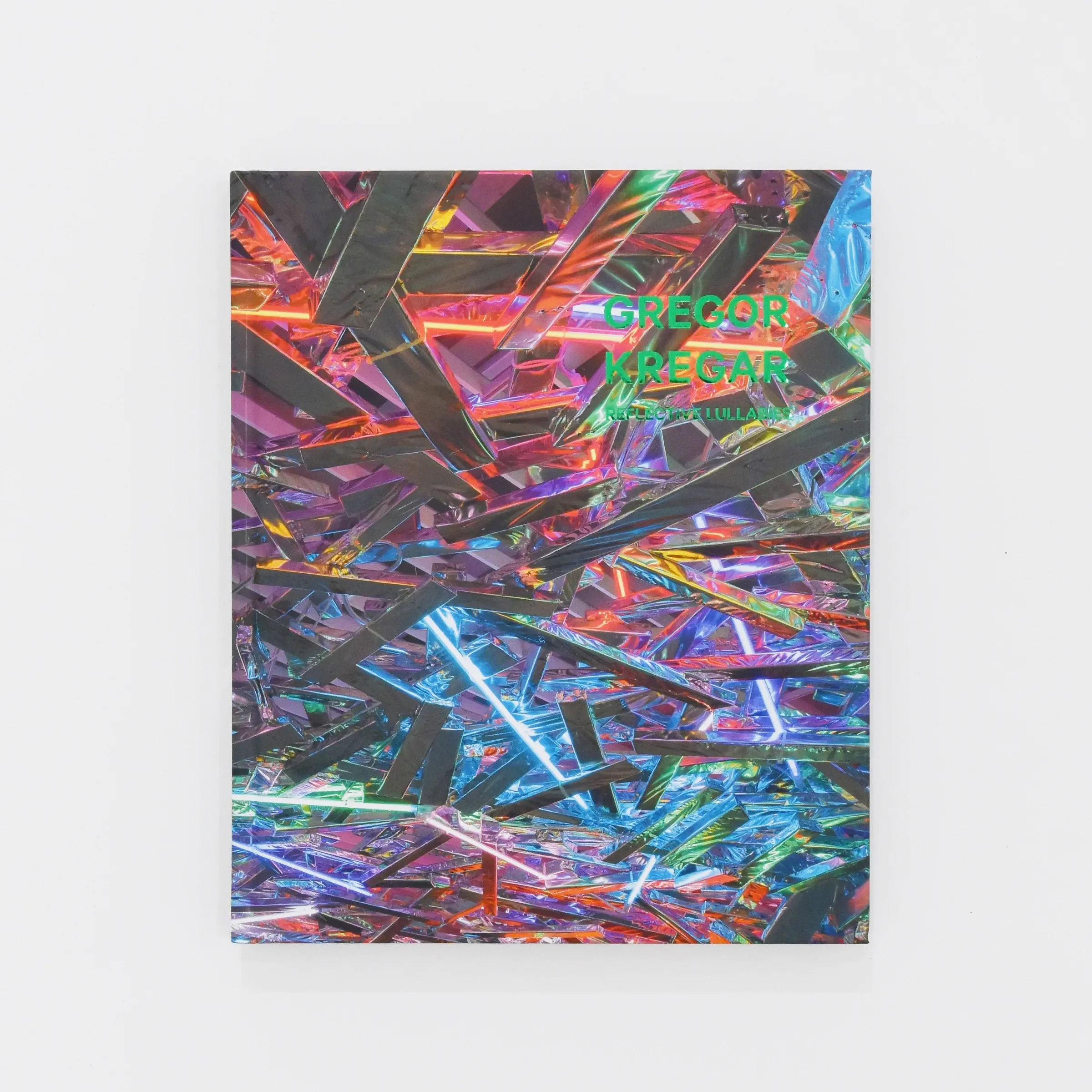
GREGOR KREGAR: REFLECTIVE LULLABY
2018
Hardback 272 pages
Publisher: Gow Langsford Gallery And Gregor Kregar
ISBN: 978-0-9941276-3-1
Dimensions: 285 x 235mm
Essays by Bruce E. Phillips, Dr. Lara Strongman, Mark Amery, Dr. Zara Stanhope, with foreword by Rhana Devenport
Language: English
Over the last 17 years artist Gregor Kregar’s sculptural practice has increasingly involved architectural spaces and social engagement. Through this body of work, Kregar advocates for the constructive potential of waste materials and our ability to use them to reconfigure our reality. His artistic strategy also parallels the theories of relational geographer Doreen Massey and others who have attempted to conceive of ways to curb our impending social and ecological crises. Specifically, pertinent to Kregar’s work are Massey’s three main concepts of space being a dimension of temporal multiplicity, relational flows, and of change and its responsibilities. These three aspects provide an apt lens through which to trace the social and ecological significance of Kregar’s architectural works from his first work -archie(2001) through to the Dream House Project(2012) and The Glass Pavilion(2017).
TEMPORAL, MULTIPLE AND SIMULTANEOUS
Our age of consumerism is flowing at a pace that is wearing us and the earth to the bone. Doreen Massey argues that this capitalist-driven flow, characterised by a dominance of time, is a destructive force that devalues the environment and also the possibility for us to imagine equality in our social and political relations. She argues instead for a refocussing on ‘space’ as opposed to time. The dimension of space, she contends, is not the singular and static concept we have been led to believe. Rather, space is a temporal multiplicity—meaning that it is made of many histories, lives and geographies existing together simultaneously and because of this space provides a way for us to consider our equivalence with each other and the earth.[1]
Considering space as a temporal multiplicity, provides a unique way in which we can view Gregor Kregar’s architectural works which seek to attain, in Massey’s words, “an imagined space of interaction”.[2] This is especially the case in -archie(2001), Kregar’s first large-scale installation. Sited at the entrance to Wellington City’s Civic Square, -archiewas a 8-metre-high by 12-metre-wide rectangular archway built with a scaffold exoskeleton. Inside, this construction contained a stockpile of discarded consumer products all coated in a unifying layer of red paint. Standing for only two weeks as part ofChanging Spaces, an exhibition of temporary public artworks across Wellington, the sculpture was then disassembled and the objects offered to the public to take home and admire, reuse, recycle, or be delivered to the dump.
Upon first glance, the solid red form appeared monolithic and singular amongst the surrounding urban environment, especially when viewed at a distance from the plaza or opposite street corner. Yet the closer one approached, its homogeneity gave way to its multiplicity. As passers-by recognised the sculpture’s individual components they seemed to be drawn in for closer inspection. In part, this was due to the commonplace nature of the objects: old tube televisions, plastic chairs and boxes, an umbrella, a wheel-barrow, car parts, an armchair, drawers, a bathroom basin, a coffee table, book cases and pallets. Despite these objects predominantly being rubbish, people from all walks of life could relate to the work via their individual connections and experiences of such everyday objects. Through this relational encounter, if only for a brief moment, many people shared the simultaneity of space in equivalence with others of which Massey refers to as a ‘dimension of respect’.
This notion of shared consciousness is also significant in the fact that Kregar built -archieout of Auckland’s waste and not Wellington’s. The transposition of rubbish from Auckland to Wellington suggests that while populations are geographically distanced and distinct we are all ultimately interconnected in a simultaneity of space. What happens in Auckland affects Wellington and vice versa and so on between cities and nations the world over. In early 2018, this global interdependence was highlighted when China stopped the importation of waste plastic and paper for recycling—an issue that is impacting cities across New Zealand and around the world. Many cities have been forced to stockpile their unwanted waste, pay exorbitant fees to have it processed elsewhere or send it all to landfill.[3]
The movement of waste from Auckland to Wellington could alsoallude to the fact that while Wellington is the capital city and seat of governmental power, it is the population and corresponding economic power of Auckland that, by the logic of our capitalist age, matters more. Thus, the maintenance of such an economic hagiarchy and its corresponding social and environmental impact, is reinforced by capitalism. According to human ecologist Jason W. Moore, a key part of capitalism’s power is that it also creates a type of cognitive disempowerment. “So long as the radical political imagination is captive to capitalism’s either/or organisation of reality: Nature/society”, writes Moore, all “efforts to transcend capitalism in any egalitarian and broadly sustainable fashion will be stymied”.[4]By emphasising the dominant capitalist mode of thought behind social and ecological crises, Moore, like Massey and Kregar, challenges us to reshape the thinking that has us so deeply entrenched in our habits, institutions, infrastructures and economies.
The need to more blatantly confront the capitalist system no doubt led Kregar to conceive of Archie 2(2006) which was proposed to be sited in front of the Bank of America in Charlotte, North Carolina. Archie 2was envisaged to be installed in 2007 and consisted of a vertical rectangular column reflecting the bank’s proud skyscraper building. While apparently gaining some initial traction with the bank, the proposal was ultimately rejected on ideological grounds. Only a year after Archie 2’splanned installation the global financial crisis hit, and the fallout revealed the bank’s role in many counts of mortgage fraud. The physical ramifications of the financial crisis created substantial urban degradation and corresponding material waste across the United States and the world.
RELATIONAL FLOWS AND POWER-GEOMETRIES
So far we have considered Kregar’s practice in relation to Doreen Massey’s concept of ‘temporal multiplicities’ as a way to understand how space “is the essential dimension ofrespect”[5]—as opposed to the capitalist weaponization of time which results in social and ecological exploitation. Looking at a second aspect of Massey’s theory on space, how relational flows comprise the spatial, brings us to a compelling way to unpack the social engagement that Kregar often seeks out through his architectural works. Massey writes:
Space . . . is the product of relations—of flows, interconnections, practices of engagement of all kinds—from the immensity of the global to the intimacy of the spatiality of the home.[6]
As part of this theory, that space is relationally constituted, Massey explains that within these relations resides political power that situates us all within a great network of local and global interconnections. She terms this ‘power-geometries’—a flow of power relations that can be spatially mapped. In many ways Kregar’sDream House Project(2012) intervened within such power-geometries and relational flows through an expansive installation and social-engagement project produced and commissioned by the art gallery Te Tuhi in Auckland.
Upon entering Te Tuhi, visitors to the Dream House Projectencountered an enormous timber structure that engulfed the gallery’s foyer in a complex web of wooden refuse. Inhabiting the building like a giant bird’s nest, the structure was conceived to create a sense of sanctuary but also to be a functional space that visitors to Te Tuhi could walk through, sit amongst and socialise in. Constructed out of 4 tonnes of reclaimed timber, this elaborate work was drawn directly from the impact of New Zealand’s leaky building crisis which led to thousands of domestic and commercial buildings being demolished across Auckland from the late 1990s through to the early 2000s.[7]As a result, an influx of building waste flooded the city’s dumps forming mountains of timber refuse. The planning for the Dream House Projectalso coincided with the aftermath of the Christchurch earthquake and tsunami devastation of Fukushima in 2011. Images of mangled debris were therefore an unavoidable influence for Kregar. In a similar vein, the economic wastelands of foreclosed homes across the United States and in other countries, as a result of the 2008 global financial crisis, might have also been an influence. By considering these relational flows of urban collapse, Kregar was motivated to consider how such cities might conceive of a new spatial reality by utilising the material resource of their destruction.[8]
This thought led Kregar to consider the importance of imagination as a crucial tool in the makingof place. In an adjacent gallery as part of the Dream House Project, he exhibited a room filled with geodesic cardboard dreamhouses made by over 300 children from a local school. These dreamhouses were created during a lesson in triangular geodesic structure taught by Kregar and Te Tuhi educator Jeremy Leatinu’u. During this class the children quickly harnessed the logic to develop complex tessellated forms in which imagined inhabitants, including princesses, robots, aliens and animals, found sanctuary.[9]Installed within the gallery space the children’s cardboard designs took on the likeness of cloud clusters, recalling architect Buckminster Fuller’s aspirations for a floating geodesic city.
In 1962, Fuller imagined a floating city of Cloud Structuresthat could conceivably liberate humankind’s dependency on the earth and alleviate the politics of land ownership, housing shortages and aid the conservation of nature. Fuller’s visionary floating architecture and commitment to the human condition and nature have long been a point of inspiration for Kregar. Similar to Massey, Fuller understood the importance of our relational interdependency. This manifesto was epitomised in Fuller’s 1969 book An Operating Manual For Spaceship Earth in which he advocated for a type of creative education that was free from specialisation and restrictions as key for overcoming our destructive tendencies. Fuller writes:
in observing a little child, we find it is interested in everything and spontaneously apprehends, comprehends, and co-ordinates an ever expanding inventory of experiences . . . Nothing seems to be more prominent about human life than its wanting to understand all and put everything together.[10]
Similarly, Kregar sought to harness this ability of imagination that comes so readily to the youth, to dream of a different reality than that of our present. And with the hope that they might value this tool of imagination as adults to reshape their future. The power of imagination, and indeed of dreaming, echoes the thoughts of curator Nato Thompson. In his book Seeing Power: Art and Activism in the 21stCentury, Thompson claims, like Massey, that “space is where the battle is” and that “people—and—dreams are a powerful resource who, historically speaking, have created their own worlds in spite of the powers that oppress them . . . If art is a dream, then it is a dreaming best done in—and with—the public.”[11]
A year later, Kregar evolved his dreaming further to realise the Pavilion Structure(2013) for Headlands Sculpture on the Gulf, on Auckland’s Waiheke Island. Significantly larger in scale than the Dream House Project, the Pavilion Structureemphasised a slightly different form of public engagement. Prominently sited on the headland overlooking Matiatia Bay, this gigantic timber constructionwas a surreal sight in comparison to the multimillion dollar houses and estates nearby. In terms of relational flows and power-geometries, it would be remiss not to consider the political significance of Kregar transporting 11 tonnes of leaky home timber waste from a dump in Henderson and delivering it to the doorstep of Auckland’s most wealthy citizens. Yet, Pavilion Structure was more than a political gesture. It also functioned as a support for participation and action; located in each archway of the Pavilion StructureKregar included a swing which beckoned public interaction. This interaction transformed the construction into a space that seemed to breathe with the motion of bodies swinging in and out of the pavilion archways. Balancing this energetic activation was a seating area built around the pavilion’s central column where people could rest. While Pavilion Structure was less overtly educational than the Dream House Project, it revealed how the design of physical space alone can support individual action and create an environment for social interaction. In her analysis of public assembly, political theorist Judith Butler contends that understanding this relational flow, between the material and the social, is a crucial factor for rethinking societal infrastructures. Butler explains:
Human action depends upon all sorts of supports . . . the capacity to move depends upon instruments and surfaces that make movement possible, and that bodily movement is supported and facilitated by non-human objects and their particular capacity for agency . . . those material environments are part of the action, and they themselves act when they become the support for action.[12]
THE RESPONSIBILITY OF CHANGE
Following on from theDream House Projectand Pavilion Structure, Kregar continued to explore this capacity for social activation through the material environments that Butler describes. Subsequent works exhibited at Auckland’s Gow Langsford Gallery included New Structures(2013)—a timber structure that incorporated hundreds of recycled neon tubes from the signage industry. Combining inspiration from -archie andNew Structures, Kregar also produced Luminous Passage (2015) an archway for the Sydney Contemporary art fair held at Carriageworks.
Further material and spatial experiments led Kregar to utilise a stockpile of more than 3,000 glass panes by melting and casting them into bricks — mimicking the dimensions of concrete cinder blocks. The glass came from the liquidation of an Auckland furniture company and would otherwise have been destined for the dump. Several works grew from this unwanted glass resource, beginning with modest scaled wall-like constructions such as The Lost World(2015-2016) exhibited in different permutations at Gow Langsford Gallery and Hastings City Art Gallery. Kregar then began developing larger constructions. Returning another year to Waiheke Island for Headlands Sculpture on the Gulf, Kregar built Glass Room(2017) a circular 7.5 metre diameter glass block structure permeated by neon tubes and furnished with a recycled wooden floor and seat.
This larger glass, timber and neon construction signalled a degree of conceptual, material and social complexity that engaged with space on a different level from Kregar’s previous works. To draw out this complexity we can apply the third and final aspect of Massey’s understanding of space—that space changes and we have responsibility to this change. On this aspect she concludes:
Space, then, to summarise, is the simultaneity of all those ongoing stories and their power-filled connections. It is therefore constantly changing, constantly being made. To the degree that it is a social and political product there is therefore always the crucial ethical and political question of howit is constructed, and our duty in relation to that.[13]
This call to action—to take responsibility for spatial change—is exemplified within Kregar’s work The Glass Pavilion(2017) commissioned for SCAPE Public Art Biennial in Christchurch. Reflecting on the substantial earthquake damage to the city, Kregar created an intimate space for hanging out, discussion and solitary thought that was sited alongside the Avon River in the city centre. The use of the glass blocks in this location took on an additional frame of reference from a recycled waste material to one of resilience and transformation.
While perceived as fragile, the glass blocks have a significant mass and are engineered in a way that makes them stronger than the nineteenth century clay brick buildings that crumbled during the 2010 and 2011 quakes. This tension was added to by the fact that glass, while typically sharp and inert to the touch, is visually and materially a type of liquid—or more accurately it is an amorphous solid—a material state between solid and liquid. And so, as the water in the river flows and as the city rises, so too is the Glass Pavilionchanging just at a much slower pace. It might be a stretch of the imagination to compare this slow material transformation of the glass blocks to the forces of nature and the critical urban changes occurring in Christchurch, but on a philosophical level it encourages a sentiment of solace in regard to change. With such an understanding in mind, sitting within the Glass Pavilion one’s body could be imagined amidst this flow of shifting relations. The contemplative aspect of this glass construction was enhanced at night by the bright glow of colourful neon tubes that were embedded within its walls. Illuminated, Kregar’s Glass Pavilion, added a sense of life and security to a city that in 2017 was still haunted by the dark windows of derelict high-rise buildings and the fact that the city’s basic infrastructure like street lights have a habit of being turned off without warning for rebuilding work.
On the rebuild of Christchurch and Massey’s provocation, that change in space is a ‘social and political product’ that has ethical implications, we must therefore question how the city is being constructed. Glass Paviliontakes up this responsibility by standing as a conceptual exercise of how the city, at least in part, could have been literally rebuilt from its ashes. This reading is reinforced by the fact that the pavilion’s floor, seating and roof was built from discarded timber offcuts from the refurbishment of the Christchurch Town Hall nearby. Through this repurposing of waste from a civic building, Kregar therefore, challenges us to consider the opportunities for change that are present right in front of us—opportunities that might enable us and our cities to take responsibility for our pressing social and environmental issues.
[1]Doreen Massey, “Tokyo Lecture: Geography and Politics,” Geographical Review of Japan Series B87, no. 2 (2015): 76–79, https://doi.org/10.4157/geogrevjapanb.87.76.Doreen Massey, “Tokyo Lecture: Geography and Politics,” Geographical Review of Japan Series B87, no. 2 (2015): 76–79, https://doi.org/10.4157/geogrevjapanb.87.76.
[2]Massey.
[3]Kathryn Ryan, “Warnings over NZ’s Kerbside Recycling,” Radio New Zealand, April 30, 2018, https://www.radionz.co.nz/national/programmes/ninetonoon/audio/2018642762/warnings-over-nz-s-kerbside-recycling.
[4]Jason W. Moore, “Anthropocene or Capitalocene? Nature, History, and the Crisis of Capitalism,” Sociology Faculty Scholarship1 (2016), https://orb.binghamton.edu/cgi/viewcontent.cgi?referer=https://www.google.com/&httpsredir=1&article=1002&context=sociology_fac.
[5]Massey, “Tokyo Lecture.”
[6]Massey.
[7]The leaky building crisis was caused by a combination of factors including the deregulation of the building industry during the 1980s, the introduction of new building materials and a spate of poorly designed and hastily built homes to satisfy the booming residential market of the late 1990s.
[8]Bruce E. Phillips, Gregor Kregar : Dream House Project(Auckland : Te Tuhi Centre for the Arts, 2013).
[9]Phillips.
[10]R. Buckminster Fuller and Jaime Snyder, Operating Manual for Spaceship Earth(Baden, Switzerland : Lars Müller Publishers, 1969, 2008).
[11]Nato Thompson, Seeing Power: Art and Activism in the Twenty-First Century(Melville House, 2015).
[12]Judith Butler, Notes Toward a Performative Theory of Assembly(Cambridge, Mass.; London: Harvard University Press, 2015).
[13]Massey, “Tokyo Lecture.”